

Finding the Right Soil Nail Wall Contractors for Your Project
Choosing the right soil nail wall contractors is key to a successful project. For those needing earth retention or slope stabilization, finding a trustworthy and skilled team is crucial.
Here’s what to look for when selecting soil nail wall contractors:
- Geotechnical Expertise & Proven Experience: Contractors should have a deep understanding of soil mechanics and a strong track record.
- Strong Safety Record & Quality Control: A commitment to safety and quality ensures your project is built to last.
- Specialized Equipment & Skilled Crews: The right tools and experienced personnel are vital for efficient installation.
- Design-Build Capabilities: Contractors who manage both design and construction offer a more streamlined process.
- Positive Client Testimonials & Local Knowledge: Reviews and familiarity with local soil conditions indicate reliability.
For property owners in the Oklahoma City area, finding a dependable contractor can be a challenge. A soil nail wall is an advanced earth retention system used to stabilize slopes, support excavations, and prevent landslides by creating a reinforced soil mass. This guide will help you understand soil nail walls and how to select the best contractor, avoiding common issues like poor communication or shoddy workmanship.
What is a Soil Nail Wall? A Foundation in Geotechnical Support
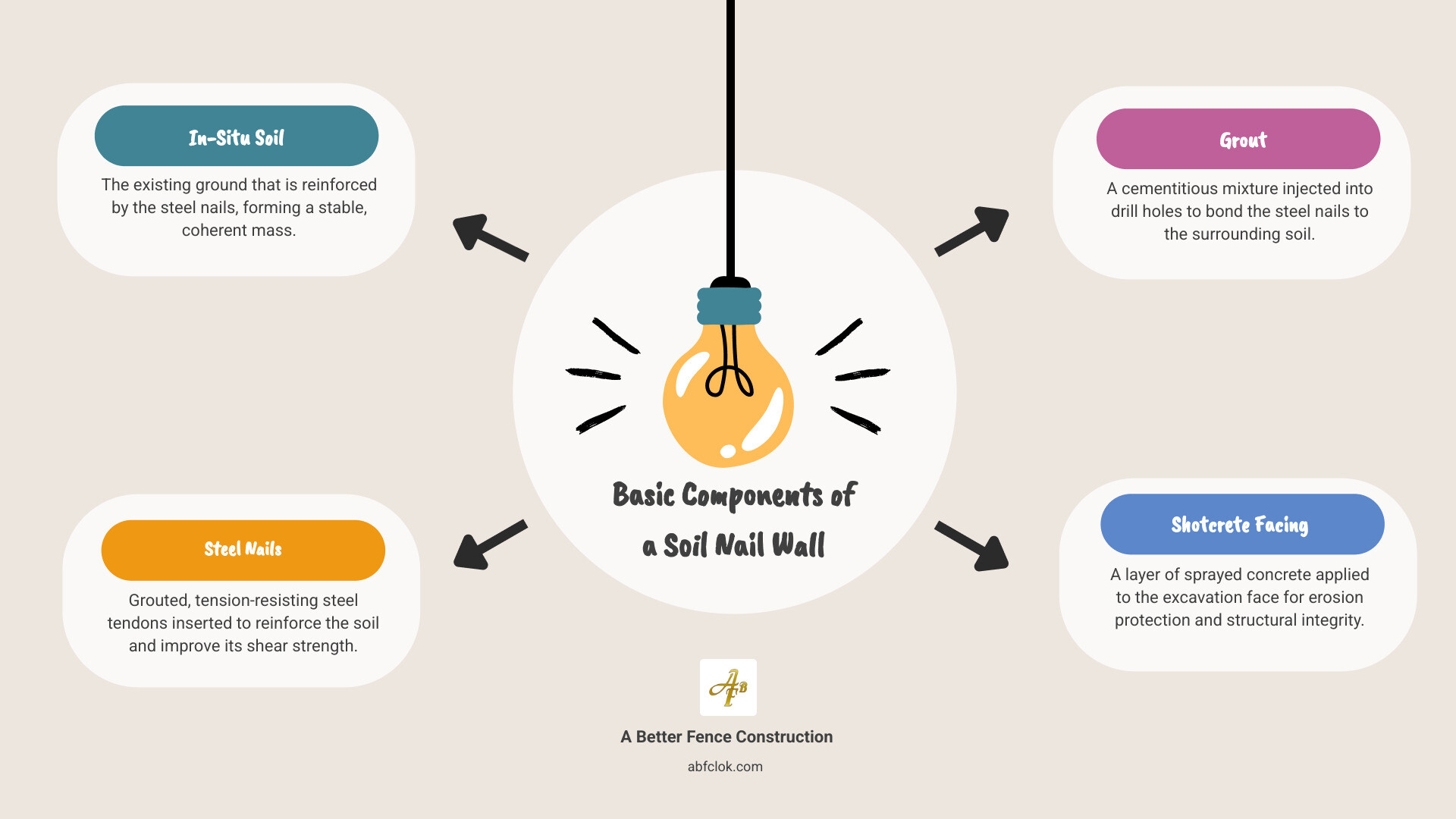
A soil nail wall is a geotechnical construction technique used to make unstable ground strong and secure. By inserting steel rods, or “nails,” into the existing soil and securing them with grout, the method creates a firm, reliable foundation for both temporary and permanent projects. For a general overview of the technique, see Soil nailing.
It is a “passive system,” meaning the nails are not tensioned upon installation. Instead, they work with the in-situ soil (the earth that’s already there) to boost its strength and help it resist pressure. By placing steel tendons and filling the holes with grout, a strong, unified block of earth is formed, creating a coherent gravity wall. This reinforced soil mass holds back significant pressure, keeping slopes and excavations stable. The process is typically done using top-down construction and finished with a durable shotcrete facing.
How the Installation Process Works
The installation of a soil nail wall is a precise, top-down process performed in manageable stages to ensure the ground is always supported.
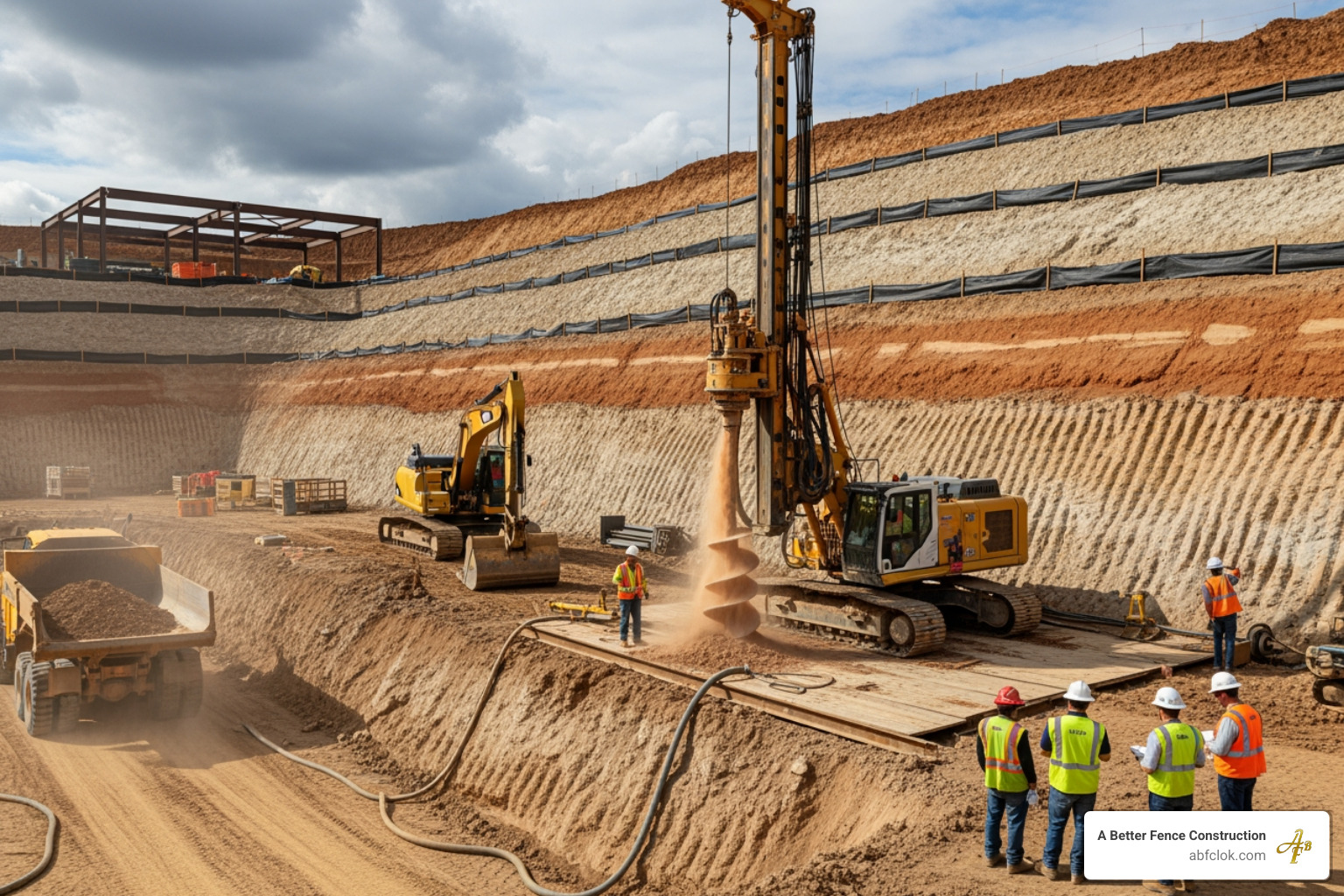
Here is a brief overview of the installation process:
- Initial Excavation: A horizontal strip of soil, typically 3 to 6 feet deep, is excavated to create a temporary open face.
- Drilling Holes: A series of holes are drilled into the exposed soil, spaced according to the project’s design.
- Nail Insertion and Grouting: Steel reinforcing bars (the “nails”) are inserted into the holes. The nails are un-tensioned and placed at a slight downward angle. The hole is then filled with grout, which bonds the nail to the surrounding soil to create a unified soil mass.
- Drainage System Installation: A drainage system, such as weep holes or drainage strips, is installed to manage water pressure and ensure long-term stability.
- Shotcrete Application: A layer of reinforced shotcrete (concrete applied with high pressure) is sprayed onto the soil face. This acts as the wall’s facing, providing erosion control and holding the soil between the nails.
- Bearing Plate Installation: Bearing plates are attached to the ends of the nails to help distribute pressure from the shotcrete facing.
- Repeating the Cycle: The process is repeated for the next section below, continuing stage by stage until the wall reaches the required depth.
This step-by-step approach minimizes risk and makes the construction process highly efficient.
Applications and Advantages of Soil Nailing
Soil nail walls offer strong solutions for many ground challenges, making them ideal for Oklahoma City’s unique soil conditions. They are perfect for stabilizing slopes, preventing landslides, supporting deep excavations for buildings and infrastructure, and reinforcing existing retaining walls.
Choosing a soil nail wall brings several key benefits:
- Cost-Effective: Soil nailing is often a more budget-friendly option for excavation support compared to traditional methods.
- Faster Projects: The top-down construction and use of smaller equipment can significantly speed up project timelines.
- Ideal for Tight Spots: The compact equipment used for installation makes soil nailing perfect for limited access areas, such as busy urban sites.
- Minimal Disruption: The installation process causes minimal disturbance to nearby properties and structures, a major advantage in developed areas.
- Flexible Design: Soil nailing offers great flexibility in design and construction, easily adapting to curves or changing site conditions.
- Less On-Site Fabrication: Very little steel fabrication is needed on-site, which further accelerates the construction process.
Comparing Soil Nailing to Other Retention Methods
It’s helpful to see how soil nailing compares to other common methods. While every technique has its place, soil nailing often has clear advantages.
| Feature | Soil Nailing | Ground Anchors (Tie-backs) | Gravity Walls (e.g., Concrete) | Soldier Pile and Lagging |
|---|---|---|---|---|
| Mechanism | Passive reinforcement of existing soil, creating a reinforced soil mass. | Active reinforcement; tendons are tensioned against a structure. | Relies on its own mass to resist earth pressure. | Vertical steel piles with lagging placed between them. |
| Cost | Often more cost-effective due to faster installation and less material. | Can be more expensive due to tensioning equipment and longer tendons. | Generally higher cost due to extensive material and excavation. | Moderate to high, depending on pile depth and lagging. |
| Speed | Faster installation with top-down approach and smaller equipment. | Can be slower due to tensioning and testing requirements. | Slower due to large concrete pours and curing times. | Moderate speed; installation is sequential with excavation. |
| Site Access | Excellent for restricted sites; uses compact, mobile equipment. | Requires more space for drilling and tensioning equipment. | Requires significant space for construction and material delivery. | Can be challenging in tight spots; requires space for pile driving/drilling. |
| Soil Conditions | Best in cohesive, stable soils; unsuitable for loose sand/gravel or very wet soils. | Adaptable to various soil types, but effectiveness varies. | Best in stable, well-drained soils. | Adaptable to various soil types, but can be challenging in soft ground. |
| Nail/Tendon Length | Generally shorter nails, advantageous for limited right-of-way. | Typically requires longer tendons to reach stable ground. | No nails/tendons. | No nails/tendons. |
| Environmental Impact | Minimal disturbance, less material transport. | Can involve longer drill holes and greater ground disturbance. | Significant material use, larger excavation footprint. | Noise/vibration from pile driving can be an issue. |
Soil nails are “passive,” meaning they develop resistance as the soil begins to shift. In contrast, ground anchors (or tie-backs) are “active” and are tensioned immediately after installation to actively press against the soil. Because of this, soil nails are often shorter for the same excavation depth, making them an excellent choice where space is limited. Our expert soil nail wall contractors work with you to determine the most effective and efficient retention system for your project’s needs.
Notable Project Applications
The versatility of soil nail walls makes them suitable for a wide range of projects, from simple fixes to massive undertakings.
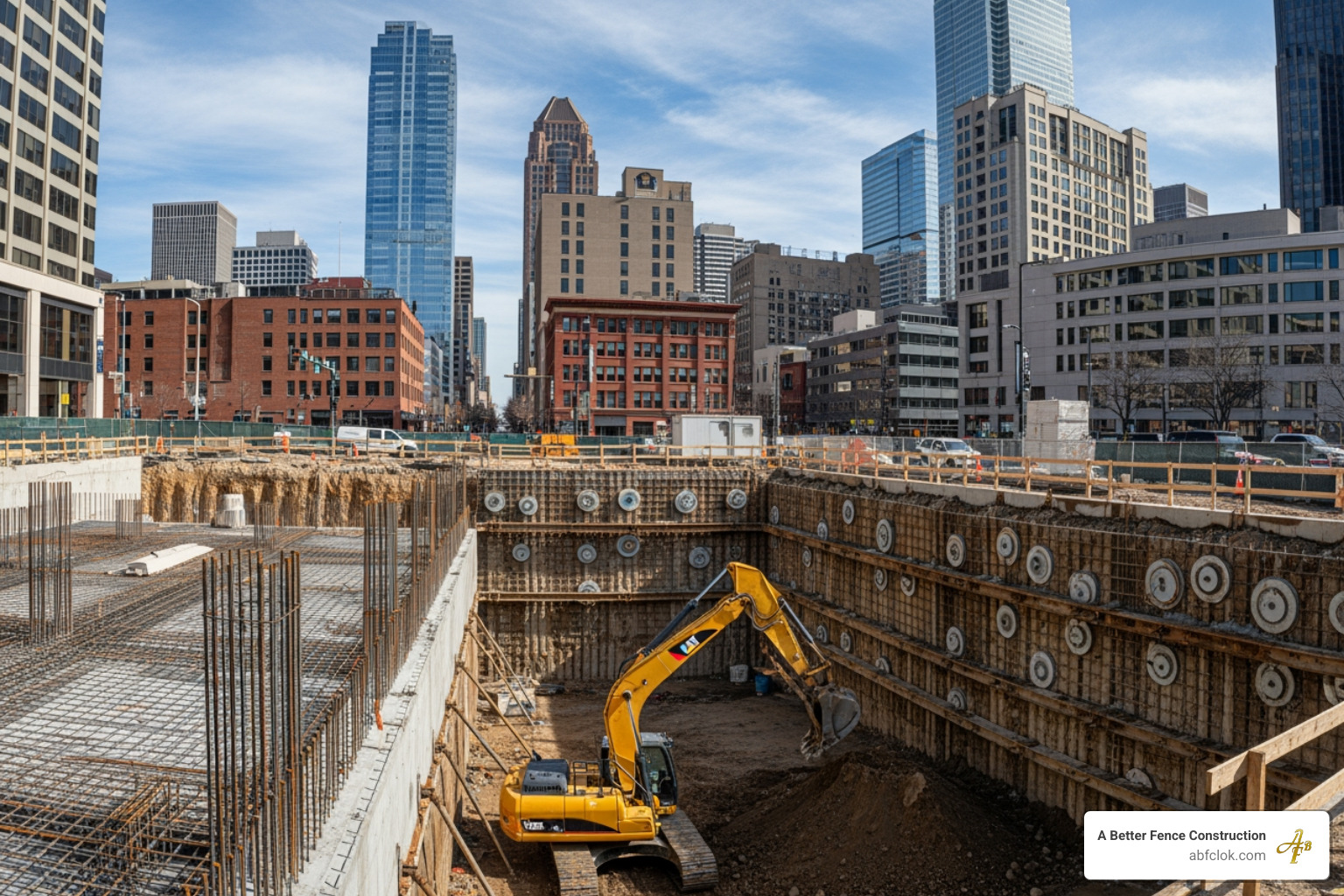
Common and impactful applications include:
- Supporting Excavations: Soil nail walls provide temporary or permanent support for deep excavations for commercial buildings, basements, or underground parking garages in Oklahoma City.
- Stabilizing Slopes: They are excellent for stabilizing existing slopes and reducing landslide risk, which is critical for projects like new roads or railways.
- Repairing and Building Retaining Walls: Soil nails can repair failing retaining walls or be used to build new ones, often as a more budget-friendly solution than traditional concrete gravity walls.
- Large Infrastructure Projects: From highway infrastructure to support for a stadium expansion or university building additions, soil nail walls offer robust support where large earth movements must be controlled.
- Landslide Remediation: In landslide-prone areas, they can be used for prevention or as an emergency slope repair to stabilize active slides.
These examples demonstrate why soil nailing is a trusted, practical solution for many geotechnical challenges.
Key Design Factors and Technical Specifications
A successful soil nail wall requires a thoughtful design process that accounts for the unique characteristics of each site in Oklahoma City. Key factors include:
- Soil Conditions: The soil’s type, strength, and behavior determine the nail length, spacing, and overall design.
- Groundwater Levels: The presence of groundwater requires effective drainage solutions to prevent water pressure from building up behind the wall.
- External Loads: The design must account for additional pressures from nearby buildings, roads, or environmental factors.
- Seismic Activity: Walls must be designed to withstand potential ground shaking.
- Drainage Design: Proper drainage is critical to prevent water from weakening the soil behind the wall.
- Global Stability: The analysis must consider the stability of the entire slope or excavation area, not just the wall itself.
These careful considerations are essential for a successful and long-lasting retaining wall.
Types of Soil Nailing Techniques
Different soil nailing techniques are used depending on the soil and project requirements.
- Drilled and Grouted Nails: The classic approach where a hole is drilled, a steel bar is inserted, and the hole is filled with grout. This method is reliable in most stable soil types.
- Self-Drilling Nails (SDNs): These hollow bars act as both the drill bit and the nail. Grout is pumped through the core during drilling, combining two steps into one. SDNs are useful in challenging ground conditions, such as collapsing soil.
- Launched Nails: In this rapid method, nails are fired into the slope using compressed air. It is often used for emergency stabilization of landslides.
- Hollow Bar Nails: This is often another term for self-drilling nails.
The chosen technique is based on a geotechnical report, soil type, and project timeline.
When Soil Nailing Isn’t the Right Choice
While highly effective, soil nailing is not suitable for every situation. It is important to recognize its limitations.
Soil nailing is generally not recommended for:
- Cohesionless Soils: In loose sand or gravel, the grout cannot form a strong bond, making the nails ineffective.
- High Plasticity Clay Soils: Very soft clays can experience “soil creep,” a slow movement that can over-stress the nails over time.
- Organic Soils: Soils rich in organic matter are often too weak and compressible to provide a stable foundation for the nails.
- High Water Tables: Saturated soil loses strength, and high water pressure can be too much for a soil nail wall to handle. Other solutions may be required in these cases.
Using soil nailing in these conditions can be ineffective and unsafe. Experienced soil nail wall contractors understand these limitations and can guide you to the best solution for your project.
How to Choose the Right Soil Nail Wall Contractors
Selecting the right soil nail wall contractors is the most important decision for your project. A properly built wall is a long-term investment in your property’s safety and stability. In Oklahoma City, choosing the wrong contractor can lead to costly problems.
Look for a contractor with geotechnical expertise, proven experience, a strong safety record, and rigorous quality control. They should also have a modern equipment fleet, design-build capabilities for a streamlined process, and deep local knowledge of Oklahoma City’s geology and regulations. As a family-owned business in Oklahoma City, we have built our reputation on understanding our local soil conditions.
Key Qualifications for Soil Nail Wall Contractors
When vetting a contractor, verify these essential qualifications:
- Licensing and Insurance: Ensure the contractor is fully licensed for geotechnical work in Oklahoma and carries comprehensive liability and workers’ compensation insurance. As a licensed, bonded, and insured family-owned business, we provide our Oklahoma City clients with peace of mind.
- Engineering Staff: Top-tier contractors have in-house geotechnical engineers or strong partnerships with engineering firms to ensure every design is structurally sound.
- Project Portfolio: A comprehensive portfolio demonstrates a contractor’s capability and quality of work on projects similar to yours.
- Client Testimonials: References from previous clients offer real-world insight into a contractor’s professionalism, communication, and ability to meet deadlines.
- Adherence to OSHA Regulations: A strong safety culture, including daily safety meetings and hazard mitigation, is non-negotiable. At A Better Fence Construction, safety always comes first.
Our commitment to outstanding customer service, meticulous work, and attention to detail is how we approach every retaining wall project, ensuring lasting quality and client satisfaction.
Questions to Ask Potential Soil Nail Wall Contractors
A thorough vetting process protects your investment. A good contractor will welcome these questions:
- Local Experience: “What is your track record with soil nail walls in Oklahoma City, and have you worked with soil conditions like mine?”
- Quality Assurance: “Can you describe your quality assurance process for installation?”
- Safety Program: “What does your safety program include, and how do you ensure compliance on-site?”
- Resources: “What equipment will you use, and what is your crew’s experience level?”
- Contingency Plans: “How do you handle unforeseen ground conditions or other complications?”
- Proof of Work: “Can you provide case studies or references for similar projects?”
- Project Management: “How do you manage timelines and budgets, and what is your communication process?”
- Scope of Services: “Do you offer design-build services, or do we need to provide an engineered plan?”
- Financials: “What are your payment terms and what warranty do you provide?”
Asking these questions will help you find a contractor who delivers exceptional results. As contractors who care about our clients’ success, we are always happy to answer these questions in detail.
Frequently Asked Questions about Soil Nail Walls
Here are answers to some of the most common questions we receive about soil nail walls from our clients in Oklahoma City.
How long do soil nail walls last?
The lifespan of a soil nail wall depends on its purpose. A temporary wall for construction support may be designed for a service life of a few months to a couple of years.
Permanent walls, however, are designed to last 75 to 100 years or more. Their longevity depends on several factors:
- Material Quality: Using high-grade steel, properly formulated grout, and durable shotcrete.
- Corrosion Protection: Protecting the steel nails from rust with methods like galvanization or epoxy coatings.
- Proper Drainage: Installing a comprehensive drainage system to prevent water from weakening the structure.
- Quality Installation: Ensuring the wall is built to exact specifications by experienced soil nail wall contractors.
When these elements are combined, a permanent soil nail wall can serve your property for generations.
Are soil nail walls noisy to install?
Compared to methods like pile driving, soil nail wall installation is relatively quiet. The process uses smaller equipment and involves drilling rather than impact-driving, which creates far less noise and vibration. This makes soil nailing well-suited for projects in noise-sensitive urban areas, residential neighborhoods, or near schools and hospitals in Oklahoma City. While not completely silent, the disturbance is minimal compared to other heavy construction methods.
Can soil nail walls have a decorative finish?
Yes, the shotcrete facing of a soil nail wall is highly customizable and can be finished to match your aesthetic goals. The surface can be transformed to improve your property’s curb appeal.
Popular options include:
- Stamped Patterns: The shotcrete can be stamped to mimic the texture of natural rock, brick, or stone.
- Staining and Coloring: The facing can be tinted or stained with various colors to complement the surrounding landscape or architecture.
- Sculpted Shotcrete: Skilled craftsmen can hand-carve the surface into realistic rock formations or custom artistic designs.
- Landscaping Integration: The wall can be integrated with plantings, climbing vines, or lighting to become part of the overall landscape design.
A soil nail wall can be both functional and beautiful, adding value to your property.
Conclusion
Understanding soil nail walls and choosing the right soil nail wall contractors is critical for a successful earth retention or slope stabilization project. This guide has provided the essential information to help you select a contractor that prioritizes expertise, safety, and quality, especially for projects here in Oklahoma City.
Finding a contractor in OKC is about finding a partner. At A Better Fence Construction, we are committed to outstanding customer service, meticulous work, and lasting quality. We apply this commitment to every retaining wall project, ensuring you receive not just a structure, but long-term stability and peace of mind.
Don’t let challenging slopes or excavation plans be a source of stress. Let us help you secure your property with a professionally installed soil nail wall built to stand the test of time.
