

Why Fence Panel Installation Is the Smartest Way to Build Your Fence
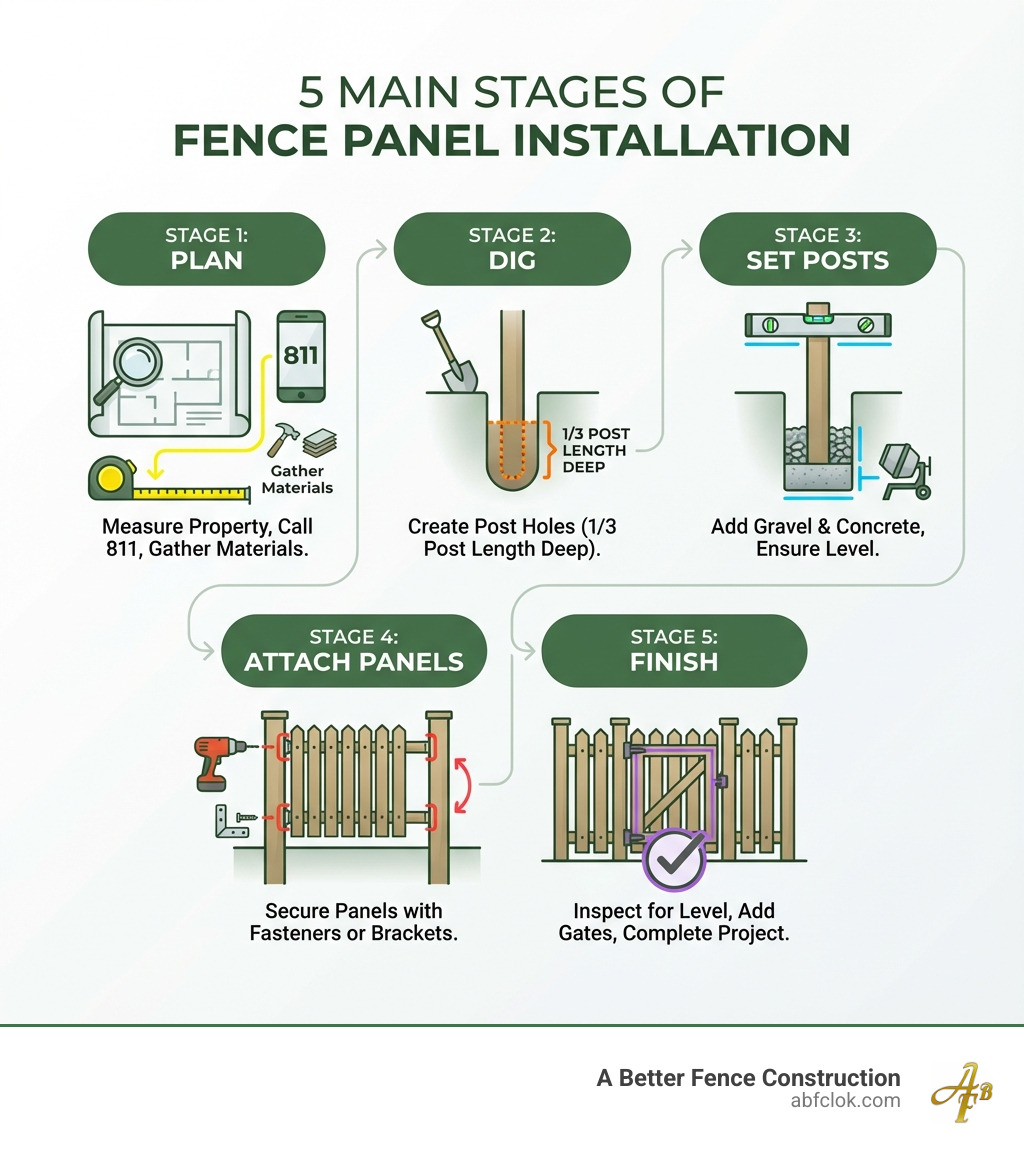
Fence panel installation is the process of attaching pre-made fence sections to posts to create a complete fence line. Here’s what you need to know:
The 5 Essential Steps:
- Plan and Prepare – Measure your property, call 811, gather tools and materials
- Dig Post Holes – Create holes 1/3 the post length deep and 3x the post width
- Set Posts – Add gravel, insert posts, pour concrete, and ensure they’re level
- Attach Panels – Secure panels to posts using screws, nails, or metal brackets
- Finish and Inspect – Check for level, add gates, and complete final touches
Why Use Pre-Made Panels?
Pre-made fence panels are one of the most efficient ways to install a fence. Standard 8-foot panels are typically 6 feet high, conforming to most building codes, and can be installed much faster than building a fence board-by-board from scratch.
Installing a fence with pre-made panels is a straightforward project when broken into manageable steps. The key is proper preparation and understanding post placement and panel attachment.
Most fence failures result from three common mistakes: shallow posts, inaccurate measurements, or skipping the 811 call to locate utilities. Avoiding these pitfalls leads to a professional, long-lasting fence.
The beauty of panel installation is that it eliminates much of the complexity of traditional fence building. You work with pre-assembled sections, ensuring consistency and speed. Posts are typically spaced 6 to 8 feet apart for standard panels, which come ready to attach.
Whether you’re adding privacy to your backyard, keeping pets safely contained, or boosting your home’s curb appeal, understanding the proper techniques for fence panel installation will save you time, money, and frustration.
I’m Jose Grados, owner of A Better Fence Construction, and I bring nearly a decade of engineering expertise to every fence panel installation project. My background in aerospace engineering taught me the importance of precision and structural integrity—principles I now apply to building fences that stand the test of time.
Step 1: Planning and Preparation
Proper planning is the most critical step to ensure your project goes smoothly, saving you time and money. Before you buy materials or break ground, handle the preliminaries.
Legal, Layout, and Safety Checks
This initial phase helps prevent costly mistakes, legal disputes, and dangerous accidents.
First, confirm your property lines using your house title documents to avoid neighbor disputes. If you share a boundary, discuss your plans with your neighbor; getting written permission is a good idea to prevent future misunderstandings.
Next, check local regulations. Communities in the Oklahoma City metro area like Norman, Edmond, and Moore have specific zoning laws, building codes, and permit requirements for fence height, materials, and placement. Obtain a building permit if required. If you have a Homeowners Association (HOA), review their rules for fence style, color, and height.
Finally, safety is critical. Before digging, you must call OKIE 811. This free service locates underground utility lines. Call at least two business days in advance to prevent dangerous accidents, costly damage, and liability. This is a non-negotiable step.
How to Measure and Plan for Your Fence
Once the legal and safety checks are complete, it’s time to get down to the specifics of your fence layout. Accurate measurements and a clear plan are the backbone of a successful fence panel installation.
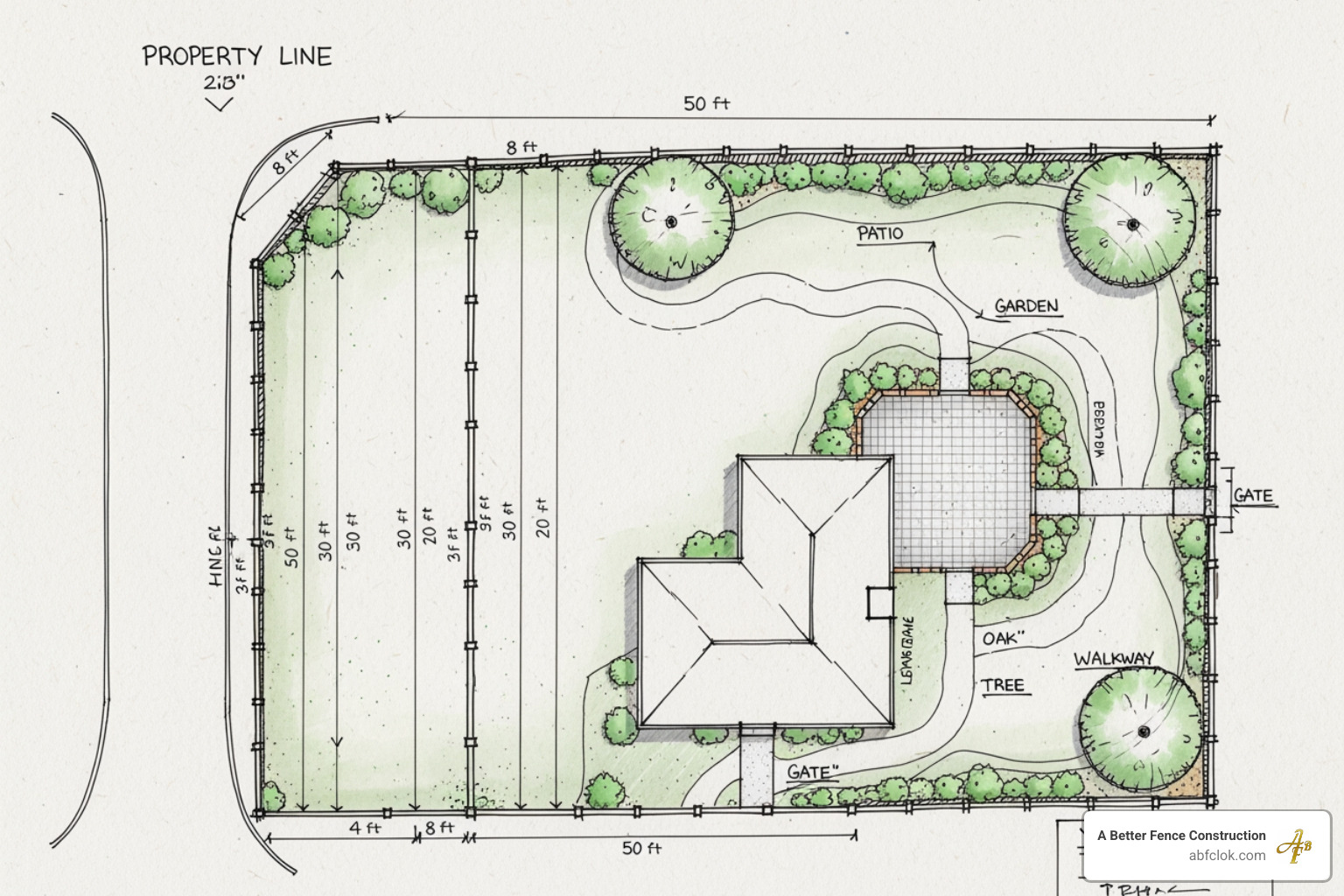
Start by sketching your property, marking the fence perimeter and any obstructions like trees or sheds. Use a long measuring tape or a measuring wheel to determine the total linear footage.
To calculate the number of panels, divide the total linear footage by the panel length (typically 8 feet). You may need to cut panels for odd-sized sections.
Space posts 6 to 8 feet apart. To calculate the number of posts, divide the total fence length by your post spacing and add one for the start. Account for gates, which require extra support posts with spacing no more than 64.8 inches (164.5 cm) center-to-center for proper function.
Mark your layout on the ground with stakes and a string line to visualize the fence line. Ensure corners are square using the 3-4-5 method: a 3-foot measurement on one side and a 4-foot on the other should create a 5-foot diagonal between those points.
If your yard has slopes, plan for either a ‘stepped’ or ‘racked’ fence, which we cover in Step 4. Always double-check your measurements before setting posts!
Essential Tools and Materials for Fence Panel Installation
Gathering the right tools and materials is crucial for a smooth installation. Here’s what you’ll need:
Tools:
- Measuring Tape: A 100-foot tape is ideal for long runs, along with a shorter one for panel measurements.
- Measuring Wheel (optional): Great for quickly covering long distances.
- Post Hole Digger: Manual clam-shell diggers work for a few holes, but a power auger (rentable) will save your back for larger projects.
- Shovel: For general digging and mixing concrete.
- Level: A 4-foot level and a post level are essential for ensuring plumb posts and level panels.
- Drill: Cordless for convenience, with appropriate bits for pilot holes and driving screws.
- Hammer/Rubber Mallet: For tapping components and driving stakes.
- Wheelbarrow: For mixing concrete and moving materials.
- Safety Glasses & Gloves: Always protect your eyes and hands.
- String Line & Stakes: For marking your fence layout.
- Marking Paint: To clearly mark post locations and utility lines.
- Circular Saw: For cutting custom panel lengths or rails.
Materials:
- Fence Panels: Choose your desired style and material – whether it’s wood, vinyl, composite, or ornamental metal. Pre-made panels are the star of this show!
- Fence Posts: These are the backbone of your fence.
- For grass contact, you’ll typically need 8-foot in-ground posts.
- For concrete surfaces, 6-foot surface mount posts with post bases are common.
- We work with various types, including wood posts for a classic look, metal posts for durability, concrete posts for unparalleled strength, and Postmaster posts, which combine steel strength with wood versatility.
- Concrete Mix: Quick-setting concrete is a lifesaver for faster curing.
- Gravel: For drainage at the bottom of post holes.
- Screws or Nails: Exterior-grade, galvanized fasteners are a must to prevent rust and ensure longevity.
- Brackets (optional): Metal brackets offer a very strong and secure connection for attaching panels to posts.
- Expansion Bolts: Needed for securing surface mount post bases to concrete or decks.
Step 2: Post Hole and Fence Post Installation
With your plan in place, the next phase is creating a solid foundation for your fence. Properly set posts are the key to a long-lasting, stable fence that can withstand the elements.
How to Properly Dig Post Holes
Digging post holes might seem straightforward, but there’s an art to it that ensures the stability of your entire fence.
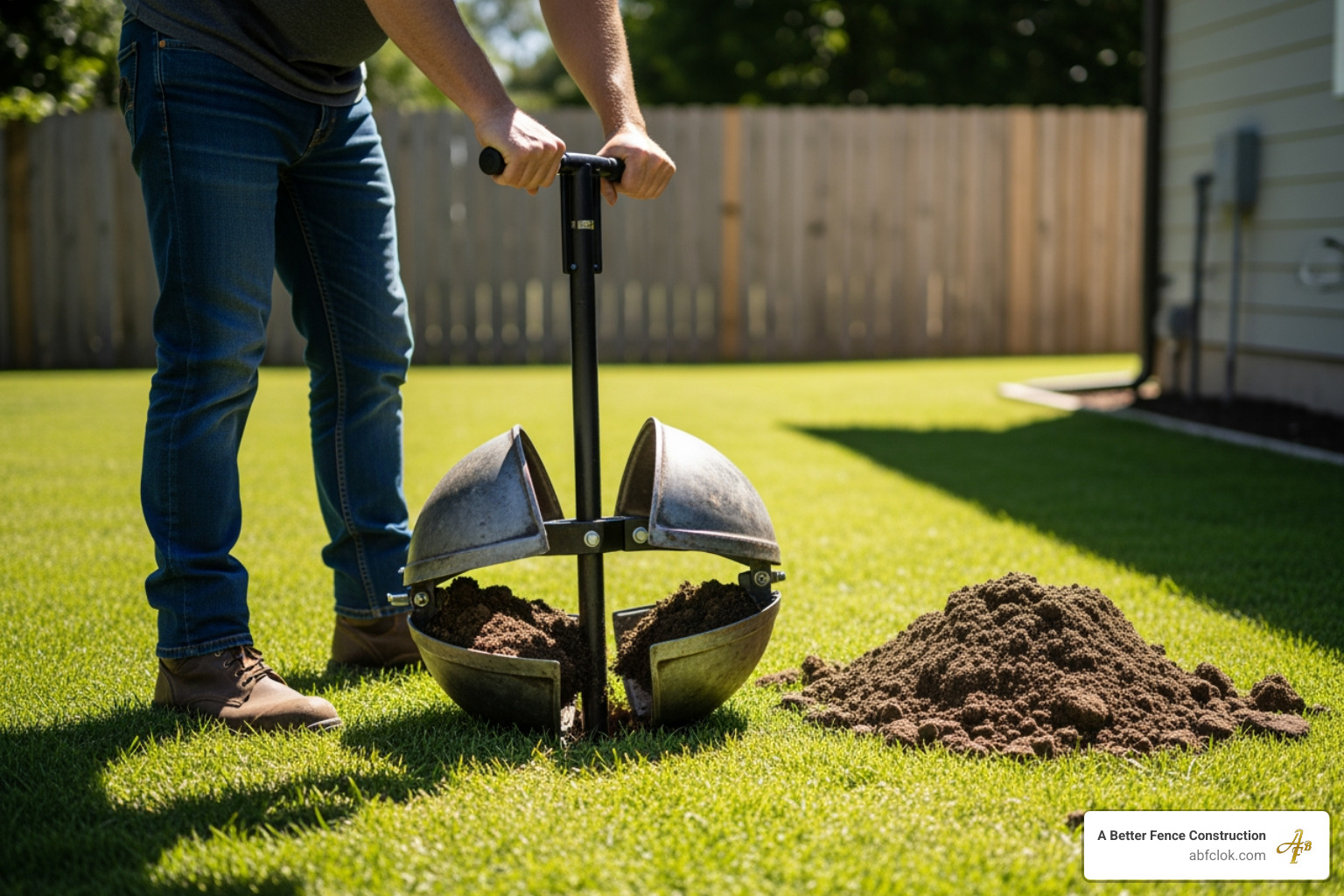
First, let’s talk dimensions. The hole diameter should be approximately three times the width of your fence post. For example, if you’re using a 2.5-inch post, your hole should be about 8 inches in diameter. This provides enough space for the concrete to properly encase the post and offer maximum stability.
The depth of the hole is even more critical. A common rule of thumb is that at least one-third of the post’s total length should be buried in the ground. So, for an 8-foot in-ground post, your hole should be a minimum of 30 inches (76.2 cm) deep. However, in colder climates like ours in Oklahoma, we must consider the frost line. The frost line is the depth at which the ground freezes in winter. If your post isn’t buried below this line, the freezing and thawing of the soil can cause the post to heave out of the ground, leading to an uneven and unstable fence. Always check local building codes for specific frost line depths in your area.
As you dig, clear any debris like large rocks or stubborn roots. These can impede proper post placement and concrete setting, creating weak points in your fence’s foundation. We want a clean, unobstructed hole for optimal post stability.
Setting Posts for Maximum Stability
Once your holes are perfectly dug, it’s time to set those posts. This is arguably the most important step in the entire fence panel installation process.
Begin by adding about 4 inches (22.2 cm) of gravel to the bottom of each post hole. This gravel layer serves as drainage, preventing water from pooling around the base of your post and accelerating rot, especially for wood posts. Tamp the gravel down firmly.
Next, carefully place your fence post into the center of the hole, resting it on the gravel. Now comes the concrete. We often use quick-setting concrete, which is a fantastic time-saver. You can either mix it in a wheelbarrow according to the manufacturer’s instructions and then pour it into the hole, or you can pour the dry concrete mix directly into the hole around the post, then add water. If adding water directly, fill the hole with water until the concrete is saturated and begins to set. For an 8-inch diameter hole, you’ll typically need around 100 lbs (45.36 kg) of concrete per post.
As you pour the concrete, keep the post perfectly plumb (vertically straight). Use a 4-foot level or a specialized post level on at least two adjacent sides of the post to ensure it’s straight. You’ll need to brace the post securely with scrap wood or stakes while the concrete cures. Quick-setting concrete usually sets in 20 to 40 minutes, but it’s best to allow it to cure for at least 24-48 hours before attaching any panels, giving it full strength. We typically fill the concrete to about 3 to 4 inches below ground level, leaving space for topsoil or sod. This helps hide the concrete and promotes better drainage away from the post base.
Step 3: A Step-by-Step Guide to Fence Panel Installation
Attaching panels correctly is key to a secure, visually appealing fence. Here are the common methods and scenarios you’ll encounter.
Attaching Panels to Different Post Types
Once your posts have cured, you can attach the panels. The method varies by post type.
On wood posts, you can fasten panel rails directly using exterior-grade screws or nails. Drill pilot holes to prevent splitting and ensure the rail has sufficient overlap on the post for a strong connection.
For metal posts, use specialized brackets. Screw or bolt the brackets to the post, then attach the panel rails to the brackets.
Concrete posts also require specialized brackets that are mortared or bolted on to provide a robust anchor for the panels.
Always use exterior-grade fasteners (galvanized, stainless steel, or ceramic-coated) to prevent rust and ensure a long-lasting connection in the Oklahoma weather.
Panel Attachment Methods: Pros and Cons
You have two main options for securing panels: direct fastening or using metal brackets. Each has its pros and cons.
| Method | Pros | Cons |
|---|---|---|
| Direct Fastening | Lower initial cost, simpler aesthetic, often faster installation. | Can be weaker if not done incorrectly, risk of splitting wood, less flexibility for adjustments. |
| Metal Brackets | Very strong and secure connection, easier alignment and leveling. | Higher cost, hardware is more visible, can add time to installation. |
Direct Fastening means screwing or nailing rails directly to the post. It offers a clean look and is often faster. However, the limited rail overlap (often just 1.5 inches) may not be strong enough for high-wind areas. If you choose this method, use long, exterior-grade fasteners to maximize strength.
Metal Brackets offer superior strength. The brackets are attached to the post, and the panel rails are secured to them. This makes leveling easier and creates a more durable connection, which is great for attaching wood panels to metal posts. While they add cost and are more visible, the structural benefits are significant. Prefabricated fence panels can be installed using either method, depending on your preference.
Handling Corners, Ends, and Custom-Sized Panels
Corners, ends, and custom lengths require finesse for a professional finish.
At corners, install the first panel’s rails flush with the post’s edge. The next panel’s rails will overlap these ends. For added stability on long runs, stagger the rail joints on different posts to distribute stress.
When finishing a run against a house, extend the panel rails to the structure and secure them firmly.
Most projects require cutting panels to fit non-standard lengths. Use a circular saw to cut a panel for any gap shorter than a standard panel—remember to measure twice, cut once. You cannot stretch a panel to fit a longer gap; instead, you must cut down a larger panel or use a combination of panels to fill the space. Always cut the final rails to fit as needed.
Step 4: Advanced Techniques and Common Mistakes
For a truly professional finish, a few advanced techniques can make a big difference, especially on challenging properties. Knowing the common pitfalls can also help you avoid costly errors.
Installing Fence Panels on Sloped Terrain
Installing a fence on a slope requires a specific approach. The two main methods are stepped and racked.
The stepped method is simpler for sloped yards. Each panel is installed level, creating a stair-step look. This leaves gaps under the panels where the ground slopes, which can be filled if needed for pet containment. This method is easier to install and works well on steeper slopes.
The racked method (or contour fencing) is more labor-intensive but provides a cleaner look with no gaps. Panels are angled to follow the ground’s contour, which may require special panels or custom cuts. This method is ideal for gentle slopes where minimizing gaps is a priority.
There’s also a less common “straight top fencing” method where the panel tops are aligned, but this can result in very large, uneven gaps at the bottom. The choice between stepped and racked depends on your slope’s steepness, budget, and containment needs. A racked fence is better for preventing small pets from escaping under the fence, while a stepped fence may leave gaps. We can help you determine the best method for your property in the Oklahoma City metro area.
Common Mistakes in Fence Panel Installation and How to Avoid Them
Knowing these common pitfalls in advance can save you significant time, money, and frustration.
- Inaccurate Measurements: Always double-check your measurements. A precise layout sketch and marked post positions will prevent panels from fitting incorrectly or leaving awkward gaps.
- Not Calling 811: Failing to call OKIE 811 before digging is dangerous and can lead to injury, fines, and costly repairs. Call at least two business days in advance.
- Setting Posts Too Shallow: This is a primary cause of fence failure. Posts not buried deep enough (at least 1/3 of their length and below the frost line) will lean or sag. Ensure adequate depth and concrete for a sturdy foundation.
- Forgetting to Account for Gates: Gates need extra support posts and precise spacing (not over 64.8 inches or 164.5 cm center-to-center) to function correctly without binding.
- Installing Panels Out of Level: A crooked fence is an eyesore and structurally weak. Use a level on every post and panel. Use temporary bracing to hold panels in place while fastening.
- Ignoring Drainage in Post Holes: Skipping the gravel at the bottom of post holes allows water to pool, accelerating rot in wood posts. Always add a 4-inch gravel layer for drainage.
- Overlooking Local Regulations: As mentioned in Step 1, ignoring local zoning laws, building codes, and HOA rules can result in fines or a forced rebuild. Always check regulations first.
- Poor Material Choices: Choosing materials unsuitable for our climate can lead to premature failure. Wood requires more maintenance than rot- and pest-resistant options like vinyl or galvanized steel.
Frequently Asked Questions about Fence Panel Installation
What are the advantages of using pre-made fence panels?
Pre-made panels offer significant time savings compared to building a fence from scratch. They ensure a consistent, uniform look and are one of the most efficient ways to install a fence, making them a great choice for DIY projects. The consistency in design and construction means your fence will have a professional appearance without the need for extensive carpentry skills. Plus, since they are factory-built, the quality control can often be higher than what’s achievable with on-site, board-by-board construction.
Should fence posts be on the inside or outside of the fence?
Typically, fence posts are installed on the inside of the property. This means the smoother, more finished side of the fence (often called the “good neighbor” side, especially for privacy fences) faces outwards, towards your neighbors or the street, enhancing curb appeal. The posts, which can sometimes be less aesthetically pleasing, are then on your side of the property. However, this is largely a personal preference. If you prefer the “finished” side facing your own yard, or if you want the posts to be a design element within your landscaping, you can certainly install them on the outside.
How do you ensure the fence panels are installed level?
Ensuring your fence panels are level is crucial for both aesthetics and structural integrity. We recommend using a good 4-foot level on top of each panel before permanently fastening it. While one person holds the panel in place, the other can use temporary wood blocks or shims underneath the panel to hold it at the correct height and ensure it’s perfectly level. It’s also important to check for plumb (vertical straightness) at each post and panel. Don’t rely on the ground’s level; always use your tools to establish a true horizontal line for your panels.
Conclusion: Your Beautiful New Fence Awaits
By following these steps, you can successfully complete your fence panel installation and enjoy the benefits for years to come. Careful planning and attention to detail are your best tools for a sturdy, beautiful fence. Whether you’re enhancing your backyard in Oklahoma City, adding security in Norman, or boosting curb appeal in Edmond, a well-installed fence makes a significant difference.
If you’re in the Oklahoma City area, including OKC, Norman, Edmond, Moore, Piedmont, Shawnee, and Midwest City, and prefer a professional touch, the experts at A Better Fence Construction are ready to help. With a commitment to meticulous work and customer satisfaction, we can bring your fencing project to life. Contact us today for a free project estimate!
