

Pre-Build Essentials: Planning Your Cedar Fence
Before we even think about digging a single post hole, meticulous planning is the bedrock of a successful cedar fence installation. This initial phase is crucial for avoiding costly mistakes, ensuring compliance with local regulations, and ultimately achieving the fence of your dreams.
Why do we love cedar so much for this crucial outdoor project? Cedar is a true champion among fencing materials. It’s renowned for its natural resistance to rot, decay, and insect infestations, thanks to its unique oils. This inherent durability means your fence will stand strong against the unpredictable Oklahoma weather, from scorching summers to icy winters. Beyond its resilience, cedar is a cost-effective material in the long run, offering excellent value compared to other options, especially when considering its ease of repair. Plus, its soft nature makes it easy to work with, resisting splitting when nailed or screwed, and accepting stains beautifully once dry.
When it comes to fence design, cedar offers incredible versatility. We can explore various styles, from the classic Board on Board that provides maximum privacy, to the neat Shadowbox style which offers a “good neighbor” aesthetic, appearing attractive from both sides. We’ll also consider the orientation of your pickets – traditional vertical or a modern horizontal design.
But before any design decisions are finalized, we must address the critical administrative steps. This includes understanding local building codes and potential permit requirements in Oklahoma City, Norman, Edmond, Moore, Piedmont, Shawnee, and the wider OKC Metro area. Our experience has shown that ignoring these can lead to fines or even the forced removal of your fence. Verifying property lines is non-negotiable; building even slightly on a neighbor’s property can lead to disputes. If you’re part of a Homeowners Association (HOA), be sure to review their specific rules regarding fence height, materials, and aesthetics. And perhaps most importantly, always call utility locators before you dig. In Oklahoma, that means dialing OKIE 811 at least two business days before any ground is broken. This free service helps identify underground gas, water, and electrical lines, preventing dangerous accidents or costly damage.
Understanding Cedar Fence Designs
Your fence is more than just a barrier; it’s an extension of your home’s style and a functional element of your outdoor living space. Privacy fences are often the top priority for homeowners, and cedar excels here. Designs like our Western Red Cedar with Cap offer a robust and attractive solution.
Horizontal fence designs have surged in popularity, offering a sleek, modern aesthetic that can make smaller yards feel larger and more open. This contemporary approach provides a unique visual appeal that stands out from traditional vertical fences. For more inspiration, check out our Backyard Fence Ideas.
Preparing the Installation Site
Once the planning is complete and all necessary approvals are in hand, it’s time to prepare the physical site for your cedar fence installation.
First, we’ll confirm and mark property lines. Sometimes, property stakes are visible, but a metal detector might be needed to find them. If there’s any doubt, a professional surveyor can provide definitive answers. We recommend building your fence slightly inside your property lines to avoid future claims or maintenance responsibilities on shared boundaries.
Next, clear the fence line. This means removing any debris, overgrown vegetation, or old fencing. We typically aim for a clear work area of at least two feet on both sides of the planned fence line.
Establishing a straight line is paramount for a professional-looking fence. We’ll use stakes and a taut string line to mark the exact path of your fence. This ensures that all posts are perfectly aligned, creating a visually appealing and structurally sound barrier.
Finally, we need to plan for slopes or uneven terrain. This is where experience truly pays off. We have two primary methods:
- Racked installation: This method follows the contour of the land, meaning the top of the fence will not be perfectly level but will smoothly follow the slope. This is often preferred for a more natural look on gently rolling terrain.
- Stepped installation: Here, the fence sections are built horizontally level, but “step” up or down at each post to accommodate the grade change. This creates a visually level top line, ideal for formal designs, but requires longer posts and careful planning for each step.
Gearing Up: Tools and Materials for the Job
A successful cedar fence installation hinges on having the right tools and high-quality materials. Just like a chef needs the right ingredients and utensils, we need our arsenal ready to build a fence that stands the test of time.
Here’s a comprehensive list of essential tools and materials we’ll typically gather for a cedar fence project:
Essential Tools:
- Measuring Tools: Long Tape Measure, Laser Level, Kreg Multi-Mark
- Digging Tools: Hand Post Hole Digger, Gas Powered Post Hole Auger (Optional), Shovel, Hi-Lift Jack (Optional for removing old posts)
- Cutting Tools: Circular Saw, Reciprocating Saw, Miter Saw (optional for precise cuts)
- Fastening Tools: Drill/Driver, Pneumatic Fencing Nailer (Optional), Hammer
- Leveling & Alignment: Post Level, Line Level, Framing Square, String Line, Stakes
- Miscellaneous: Clamps, Utility Cart, Roller (for staining), Postsaver Sleeves (Optional)
Essential Tools
For an efficient and accurate cedar fence installation, having the right tools is half the battle. We rely on a mix of hand tools and power tools to get the job done right. A good Hand Post Hole Digger is essential for precision, but for larger projects, a Gas Powered Post Hole Auger can significantly cut down on digging time. We always keep a Shovel handy for clearing debris and mixing concrete. The Post Level is our best friend for ensuring perfectly plumb posts, and a reliable Drill/Driver is indispensable for attaching rails and pickets. For cutting posts and rails, a Circular Saw offers speed and accuracy. And, of course, a sturdy Tape Measure and a general level are always within reach.
Choosing Your Materials
The quality of your materials directly impacts the longevity and appearance of your cedar fence. For posts, we typically use 4×4 cedar posts, but pressure-treated wood is also a viable option, especially for the parts buried in the ground. For ultimate durability and minimal maintenance, some homeowners opt for steel posts, including innovative Postmaster posts that combine steel strength with wood versatility. You can learn more about all the options on Our Materials page.
For the fence panels themselves, we’ll use 1×6 cedar pickets, usually rough-sawn and milled green. These are easy to work with and naturally resistant to rot. Horizontal rails are typically 2x4s, providing the structural backbone for the pickets.
When it comes to securing everything, fasteners are critical. We always recommend using exterior-rated fasteners, with Stainless Ring Shank Nails being best to prevent rust and staining of the wood. Deck screws, specifically Trim Head Screws, are also excellent for their strong hold.
For setting posts, we’ll use Fast Setting Quikcrete to ensure a solid foundation. And for gates, a robust Anti-sag Gate Kit is a game-changer, ensuring your gate remains perfectly aligned and functional for years. Finally, we’ll select a high-quality wood stain or sealer to protect your beautiful new cedar fence from the elements.
The Complete Cedar Fence Installation Process
Now for the fun part: bringing your vision to life! This section walks us through the core steps of a successful cedar fence installation, from setting the foundational posts to attaching the privacy pickets.
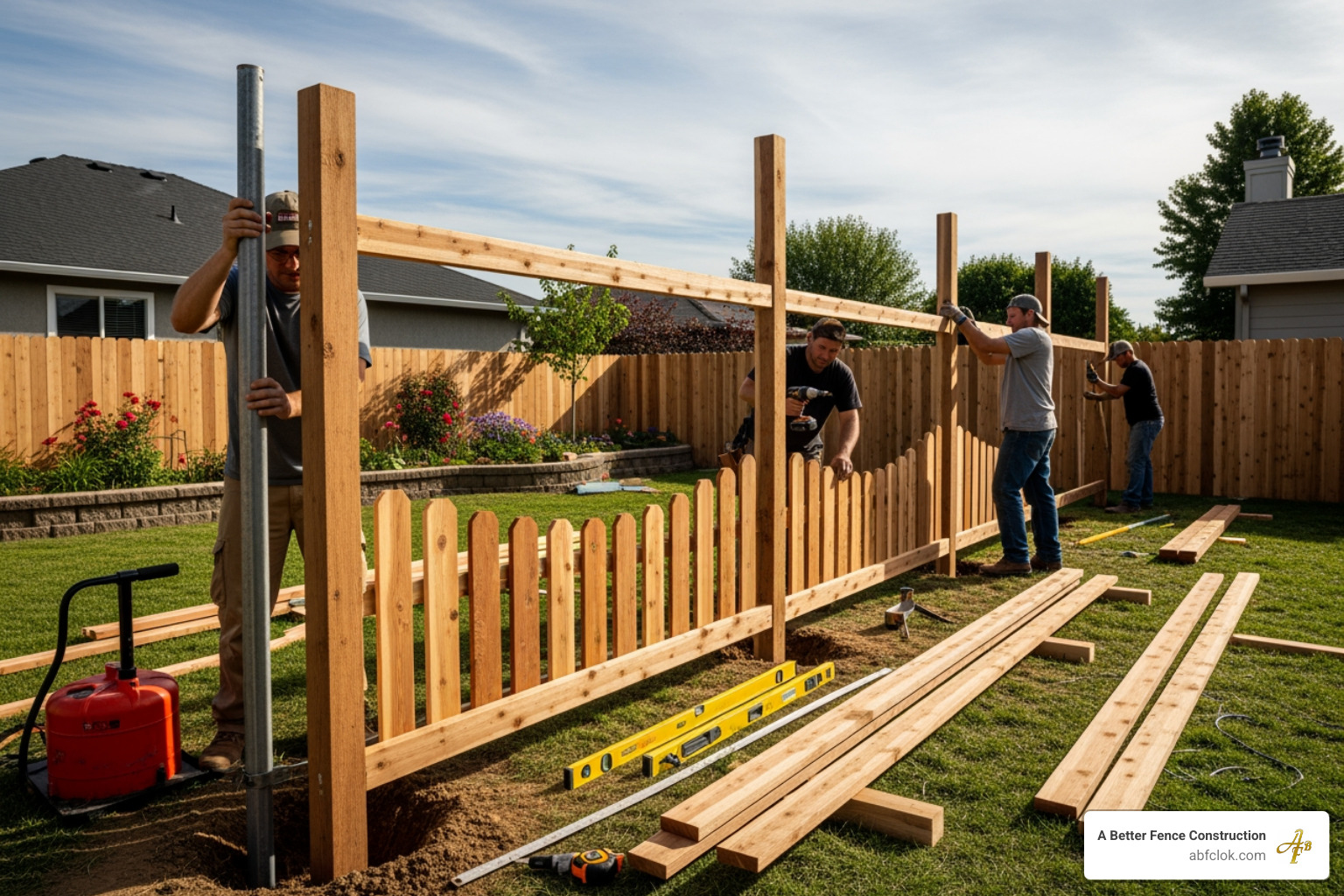
Step 1: A Deep Dive into Cedar Fence Installation Posts
The posts are the backbone of your fence, so getting them right is non-negotiable.
Post Hole Depth: A good rule of thumb is to bury at least 1/3 of the post’s total length in the ground. For a standard 6-foot tall privacy fence, this means each post hole should be approximately 2.5–3 feet (0.76–0.91 m) deep. Corner, end, and gate posts, which bear more weight, should be set 6-8 inches deeper for added stability.
Spacing Posts: We typically space posts 6 to 8 feet apart. This spacing prevents the horizontal rails from sagging over time and ensures optimal support for your pickets.
Digging Holes: After marking our post locations, it’s time to dig. For a few holes, a manual post hole digger works well. For larger projects, a Gas Powered Post Hole Auger is a true time-saver. Crucial call to OKIE 811 before you break ground!
Adding Gravel for Drainage: Once the holes are dug, we add about 6-8 inches of gravel to the bottom of each. This creates a stable base and, more importantly, promotes drainage, safeguarding your posts from rotting due to standing water.
Placing Posts: Carefully lower each post into its hole. Using a Post Level, we ensure the post is perfectly plumb (vertically straight) on at least two adjacent sides.
Bracing Posts: To hold the posts plumb while the concrete sets, we use temporary 2×4 braces screwed to the post and anchored to the ground with stakes. This prevents any movement during the curing process.
Mixing and Pouring Concrete: We use Fast Setting Quikcrete for efficiency. A pro tip: add some water to the hole first, then pour in the dry concrete mix. This ensures proper saturation and prevents dry pockets. We fill the hole, tamping to remove air pockets, and slope the top of the concrete away from the post. This crucial step prevents water from pooling around the base of the post, further protecting it from rot.
Curing Time: While fast-setting concrete sets in 15-20 minutes, it takes at least 24-48 hours for the concrete to fully cure. We resist the urge to attach rails or apply any significant pressure until this curing period is complete.
Step 2: Building the Frame with Horizontal Rails
With the posts firmly in place, it’s time to construct the frame that will support your pickets.
Rail Placement: For a 6-foot fence, the top rails should sit about 8 inches beneath the head of the support posts, while the bottom rails should terminate approximately 9 inches above ground level. A middle rail provides extra support and stability.
Attaching Rails with Screws: We attach the horizontal 2×4 rails to the posts using sturdy 3-inch deck screws. Pre-drilling pilot holes can prevent the ends of the rail boards from splitting, especially with cedar. We can also use Fence Rail Brackets for a strong, clean connection.
Staggering Rail Joints for Stability: For maximum strength, we stagger rail joints. This means that if a rail section ends on a post, the corresponding rail section on the opposite side of the post will start there, distributing stress and adding stability across the fence line.
Installing on a Slope: If your property has a slope, we refer back to our planning. For a racked fence, rails will follow the grade. For a stepped fence, we’ll install rails horizontally and adjust post heights accordingly, creating distinct sections. Our Wood Fence Installation expertise means we handle slopes with precision.
Step 3: Creating Privacy with Cedar Pickets
Now, let’s add the beautiful cedar pickets that will give your fence its character and privacy.
Attaching Pickets: For ultimate privacy, we often recommend the board-on-board technique. This involves overlapping pickets to eliminate any gaps, even as the wood naturally expands and contracts with moisture changes.
Picket Spacing: If you opt for a spaced picket design, consistency is key. We use a spacer (often a 1/4 inch piece of scrap wood, or a 4-inch spacer for horizontal designs) to ensure uniform gaps between pickets. For a privacy fence, we don’t space pickets more than 1/4 inch apart.
Securing Pickets: We attach the pickets to the horizontal rails using two fasteners per rail (six per picket for a three-rail fence). For speed and efficiency, a Pneumatic Fencing Nailer is invaluable. We always use exterior-rated fasteners, with Stainless Ring Shank Nails being the preferred choice to prevent unsightly rust stains on your beautiful cedar.
For a deeper dive into privacy fence construction, explore our Wooden Privacy Fence Construction Complete Guide.
The Finishing Touch: Building and Hanging a No-Sag Gate
A fence isn’t complete without a functional and sturdy gate. Nothing is more frustrating than a gate that sags, drags, or won’t latch properly. We focus on building gates that not only look great but also stand the test of time.

Gate Construction Basics: The foundation of a strong gate is a perfectly square frame. We build this frame using 2x4s, ensuring all corners are 90 degrees. Diagonal bracing, running from the bottom hinge side to the top latch side, is crucial for preventing sag.
Using a Steel Anti-Sag Kit: To truly guarantee a no-sag gate, we highly recommend incorporating a steel anti-sag gate kit. These kits provide robust support and allow for easy adjustments if any settling occurs over time.
Attaching Hinges: We use heavy-duty, exterior-rated hinges, typically 4-inch or 6-inch, depending on the gate’s size and weight. These are securely attached to the gate frame and the gate post with appropriate screws. Pre-drilling pilot holes is essential to prevent wood splitting.
Installing a Gate Latch: The choice of latch depends on your needs for security and accessibility. We install a durable gate latch that is easy to operate from both sides and provides reliable security.
Hanging the Gate: This step requires a bit of patience and often an extra set of hands. We carefully align the gate, ensuring adequate clearance around the frame (typically 1/2 inch) to prevent binding. Once aligned, we secure the hinges to the gate post. We’re proud to offer comprehensive Fence and Gate Companies Near Me services, ensuring every gate we install is built to perfection.
Protecting Your Investment: Finishing and Maintenance
Congratulations, your beautiful cedar fence is standing tall! But the journey isn’t quite over. The final, crucial step is to protect your investment with a quality finish and commit to ongoing maintenance. This will ensure your cedar fence installation continues to improve your property for decades.
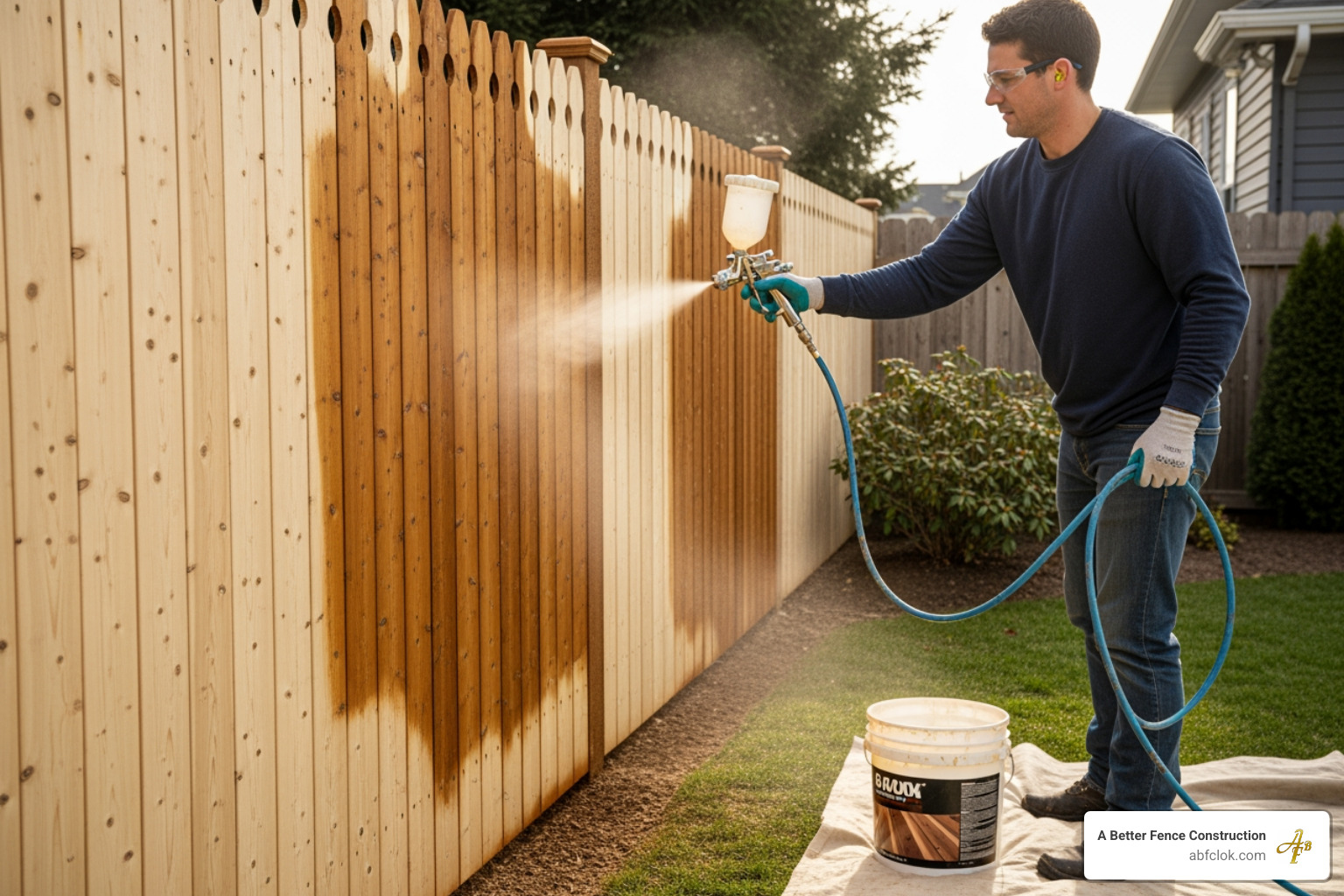
Finishing Options: Staining vs. Sealing: While cedar boasts natural resistance to decay, applying a finish significantly extends its lifespan and preserves its beauty.
- Staining: A thin layer of semitransparent wood stain or oil-based varnish seals the wood’s pores, improving its odds against the elements. Stains offer UV protection, which slows the natural graying process of cedar, and can improve or alter the wood’s natural grain. Transparent stains are popular for maintaining cedar’s inherent warmth.
- Sealing: A clear waterproofing sealer prevents moisture absorption, which is critical in preventing rot and splitting. It’s an excellent choice if you prefer the natural, unfinished look of cedar to eventually fade to a silvery gray, but still want protection.
Enhancing Wood Grain: Many stains are designed to penetrate the wood, highlighting its natural grain and texture rather than obscuring it like paint might. This allows the unique character of cedar to shine through.
UV Protection: The sun’s UV rays are a major culprit in wood degradation. Finishes with UV inhibitors act as a sunscreen for your fence, slowing down the fading and graying process, keeping your cedar looking vibrant longer.
Application Methods: For large areas, applying the finish with a Wagner Control Pro 170 sprayer equipped with a Wagner 413 Spray Tip is the most efficient method, ensuring even coverage. For smaller sections or touch-ups, a brush or roller works well. Always work one section at a time, aiming for full coverage, and don’t forget to touch up any exposed end grain, as this is where moisture is most readily absorbed.
Long-Term Care: To ensure your cedar fence lasts 15-30 years, regular maintenance is key. This typically involves annual cleaning to remove dirt, mildew, and grime, followed by reapplication of your chosen finish every few years, or as needed, depending on the product and exposure to the elements. This preventative maintenance combats problems from water absorption/loss, mildew, and UV discoloration. For comprehensive advice, check out our Fence Maintenance Tips.
Frequently Asked Questions about Cedar Fence Installation
We often hear similar questions from homeowners considering a cedar fence installation. Here are some of the most common, with our expert answers.
How do you ensure a cedar fence provides adequate privacy?
Achieving optimal privacy with a cedar fence involves a few key design and installation choices:
- Board-on-Board Design: This is our go-to recommendation for maximum privacy. It involves overlapping pickets, so that even as the wood naturally shrinks and expands, there are no visible gaps.
- No-Gap Construction: For a solid, seamless look, pickets can be installed tightly together, though some minor gapping may occur over time.
- Minimum 6-Foot Height: Generally, a privacy fence should be at least 6 feet tall to prevent others from seeing into your property. Many local codes in Oklahoma City and surrounding areas allow up to 8 feet without a special permit.
- For more ideas on how to achieve seclusion, refer to our guide on the Best Fence for Privacy.
What are the advantages of a horizontal cedar fence design?
Horizontal cedar fences offer several compelling advantages:
- Modern Aesthetic: They provide a contemporary, sleek look that complements modern home designs and landscaping.
- Perceived Space Increase: The horizontal lines can make a yard appear wider and more expansive, which is a great trick for smaller urban spaces.
- Unique Style: They stand out from traditional vertical fences, adding unique architectural interest to your property.
- Strong Design (when properly supported): While visually different, a horizontal fence, when constructed with adequate posts and rails, is just as strong and durable as its vertical counterparts.
- For a visual feast of horizontal fence inspiration, be sure to check out our Pinterest Board.
How long does a properly installed cedar fence last?
A properly installed and maintained cedar fence installation can last an impressive 15 to 30 years. Cedar’s natural durability, including its inherent resistance to rot and insects, is a major factor in this longevity. However, its lifespan is significantly influenced by:
- Maintenance: Regular cleaning and reapplication of stain or sealer are crucial. Unfinished cedar will gray and weather faster, and while it remains structurally sound, its protective qualities can diminish over time.
- Climate: While cedar is resilient, Oklahoma’s varying weather conditions, including intense sun, humidity, and occasional storms, can impact its aging process.
- Installation Quality: Proper post setting, correct fasteners, and sturdy construction all contribute to how long your fence will stand strong.
Your Beautiful New Fence: DIY or Hire a Pro?
Undertaking a cedar fence installation is a significant project, but one that offers immense satisfaction. The sense of accomplishment you’ll feel looking at your hand-built, beautiful, and functional fence is truly rewarding. You’ve learned about the benefits of cedar, the necessary tools and materials, and the step-by-step process to build a fence that improves your home for years to come.
However, we understand that not everyone has the time, tools, or inclination for such a demanding DIY endeavor. Building a fence correctly requires precision, physical labor, and an understanding of local regulations. For a guaranteed professional result, ensuring meticulous work and attention to detail, A Better Fence Construction is here to help. As a family-owned business deeply rooted in Oklahoma City, we specialize in high-quality fence construction across OKC, Norman, Edmond, Moore, Piedmont, Shawnee, and Midwest City. Our mission is outstanding customer service and lasting client satisfaction.
If you’re ready for a beautiful cedar fence without the hassle, let us do the heavy lifting. Find out Why Us and then reach out to get a free estimate. We’re just a click or a call away: Contact.
